The FA - Referees
Digital strategy

Project details

The Football Association (The FA) governs football in England and is responsible for a wide variety of activity, including developing and promoting participation at local grassroots levels, running iconic competitions like The FA Cup and supporting national teams at the FIFA World Cup.
In my role as a Product Designer & Strategist, I was primarily focused on the grassroots side of the game where I engaged with a variety of senior stakeholders from four business divisions (digital, refereeing, grassroots and safeguarding) divisions and twenty individuals across three user groups to form both short and medium-term digital strategies to deliver their respective goals.
The problem
The grassroots refereeing space across England has around 40,000 active participants and has been underserved for a number of years, particularly from a digital perspective. This lack of attention and investment has led to a fragmented digital ecosystem, which negatively impacts referee participation and satisfaction levels nationwide. This cohort plays a pivotal role in a thriving football ecosystem, meaning poor participation and satisfaction can impact all areas of the game.
Project goals
Improve collective understanding of core audiences in the refereeing space across relevant divisions where knowledge is fragmented
Understand where key challenges (both digital and non-digital) exist throughout the refereeing journey
Establish a digital roadmap for referees based on key challenges and opportunities identified, ensuring alignment with the goals of various business functions
Prior to the commencement of this project, I worked closely with my division's Product Manager to establish a continuous discovery approach and visualised what this practically meant for our day-to-day. This was intended to be a flexible approach that could be tailored to the specific needs of each project. As a foundational piece, the board helped gain collective alignment on the following:
Who owned particular activities/artefacts & when wider stakeholder collaboration was critical
What research artefacts needed to be produced at each stage
When initiatives should be handed across to delivery
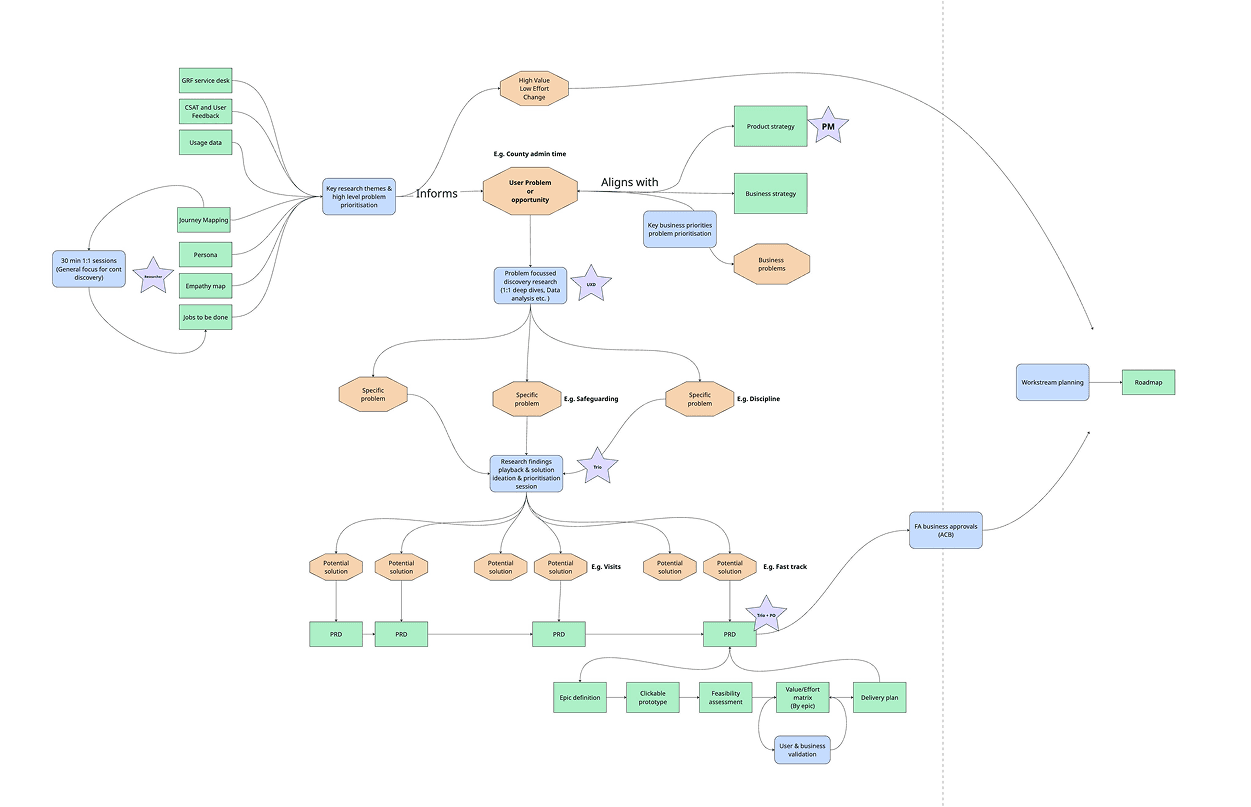
The process flow that visualised our discovery process
Below are some of the key decisions I made when tailoring the approach to best achieve the project goals outlined above.
Goal 1: Build collective understanding
Broke our 1:1 user interviews into two distinct phases. Round 1 was for breadth to identify key themes. Round 2 was for depth, to validate and explore problem areas in more detail.
Goal 2: Understand & articulate key challenges
Committed to building a very detailed user journey map to gain alignment and understanding of a very fragmented landscape.
Goal 3: Establish a digital roadmap for referees
Include tech leads & architects early to help flag key considerations for scoping & roadmap building toward the end of the project.
Interviewing round 1 - Breadth of research
Throughout the first round of interviews, the team spoke to our primary audience of referees, the research panel was made up of referees from a variety of geographic locations, demographic backgrounds and experience levels. Following the annotation and collation of notes, an affinity mapping exercise was undertaken to establish some high-level research themes:
Support gaps for newly qualified referees
Behaviour management challenges
Multiple platforms & administration burden
Scheduling and communication challenges
After playing back the key insights to the wider stakeholder group, I led the decision to group the adjacent themes into buckets. #1 & #2 felt similar as they related very much to the matchday experience, whereas themes #3 & #4 were more relevant to experiences in the lead up to and activities required after a match day.
1:1 interviews conducted across both rounds of discovery
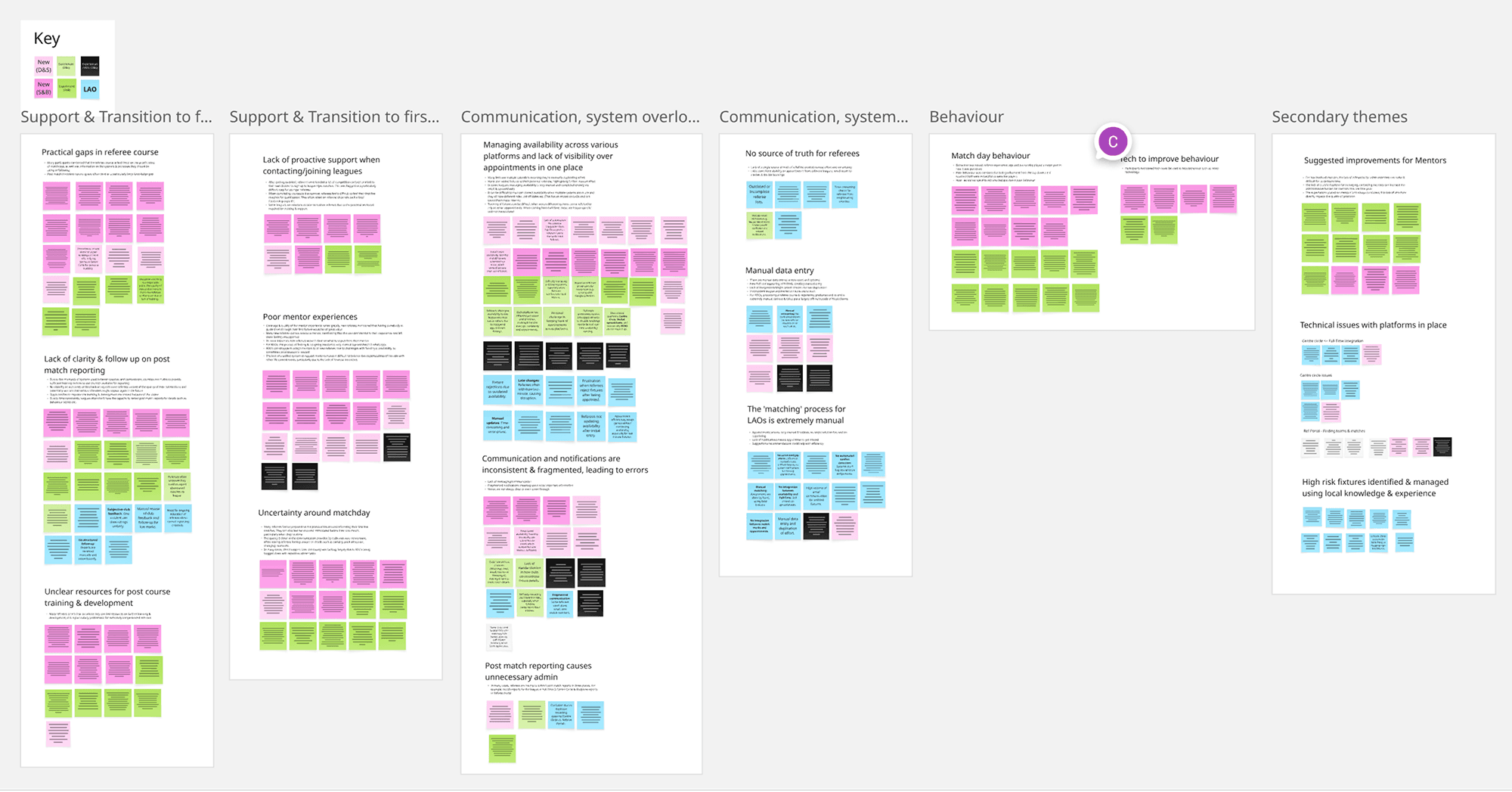
The affinity mapping process undertaken to build key themes from 1:1 interviews
Interviewing round 2 - Detailed deep dives
As part of the second round of interviews, alongside discussions with more referees we chose to speak with ancillary audiences that they interacted with along their journey. The additional interview audiences were League Appointment Officers (LAOs) who organise fixtures and appoint referees to them, and Referee Development Officers (RDOs) who are responsible for the qualification, development and progression of referees within their jurisdiction.
Given the slightly different nature of our two theme groups, I suggested we utilise bespoke interview methods to derive the most value from this second round.
Theme group #1 & #2 (Support gaps & Behaviour management)
A more traditional and open-ended discussion guide was used, this choice was made because the pain points in this space were much less tangible.
Theme group #3 & #4 (Multiple platforms/admin & scheduling/comms challenges)
I developed an initial set of process maps and asked all audiences (Referees, LAOs & RDOs) to validate these using their own experience, with a particular focus on which digital platforms they were using for what tasks and the challenges they were experiencing along the way.
This process was crucial in helping us understand the current-state digital journey, which we knew was incredibly complex and fragmented.
The bespoke exercises helped us supplement our initial themes with a greater level of detail and even helped to identify new insights that weren't evident before.
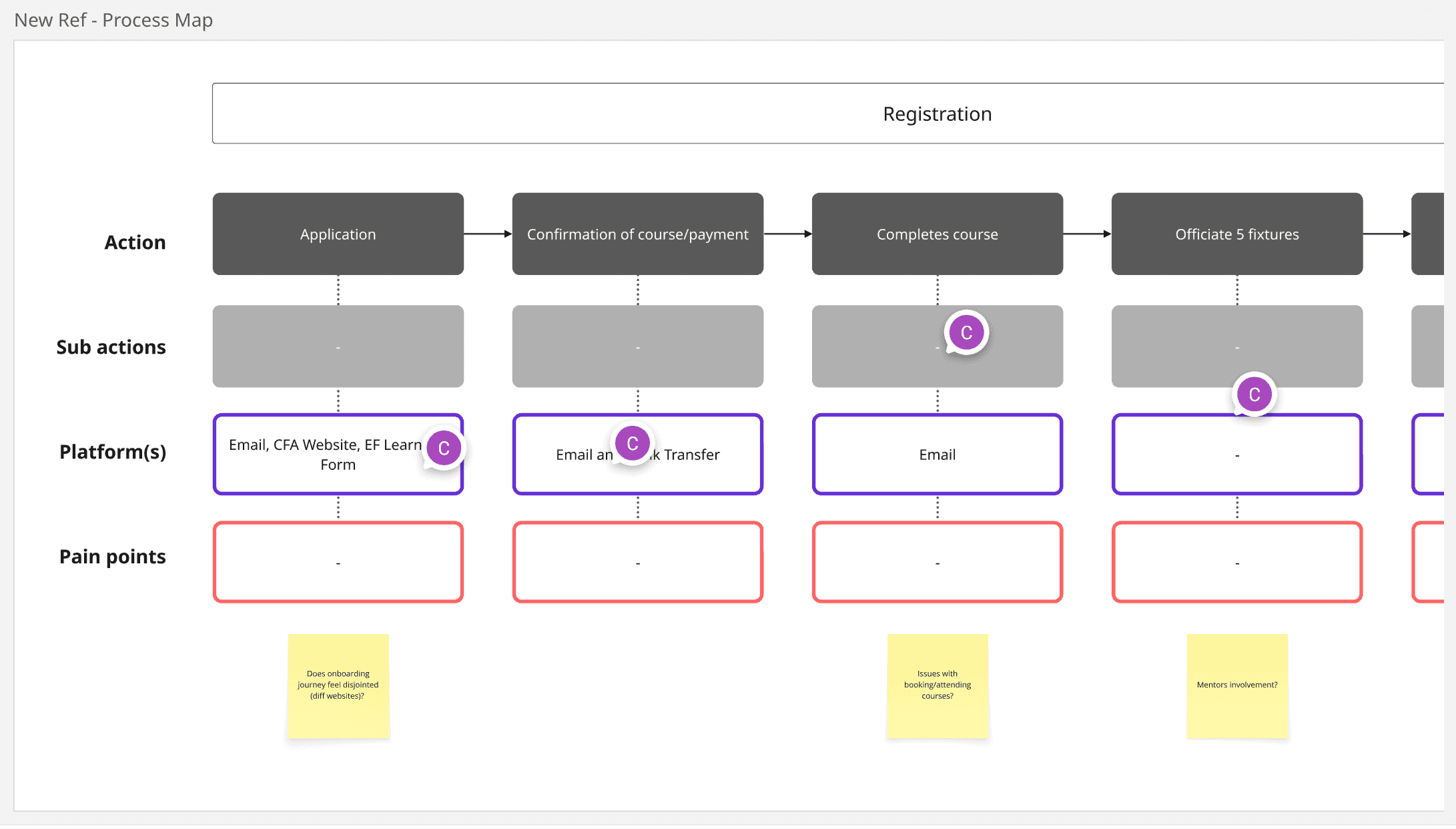
Detailed process maps for each user group were developed
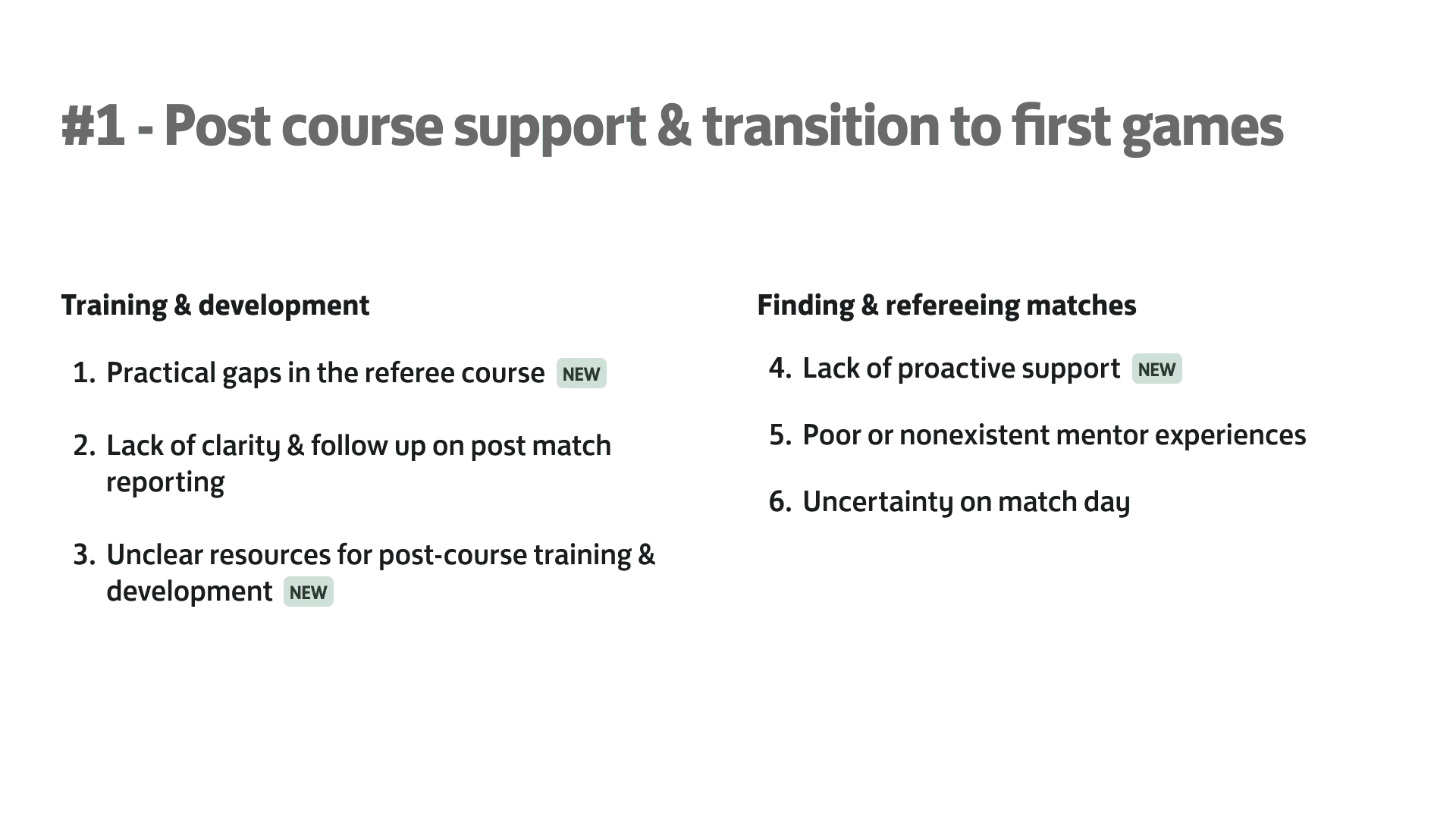
New themes & key takeaways for theme groups #1 & #2
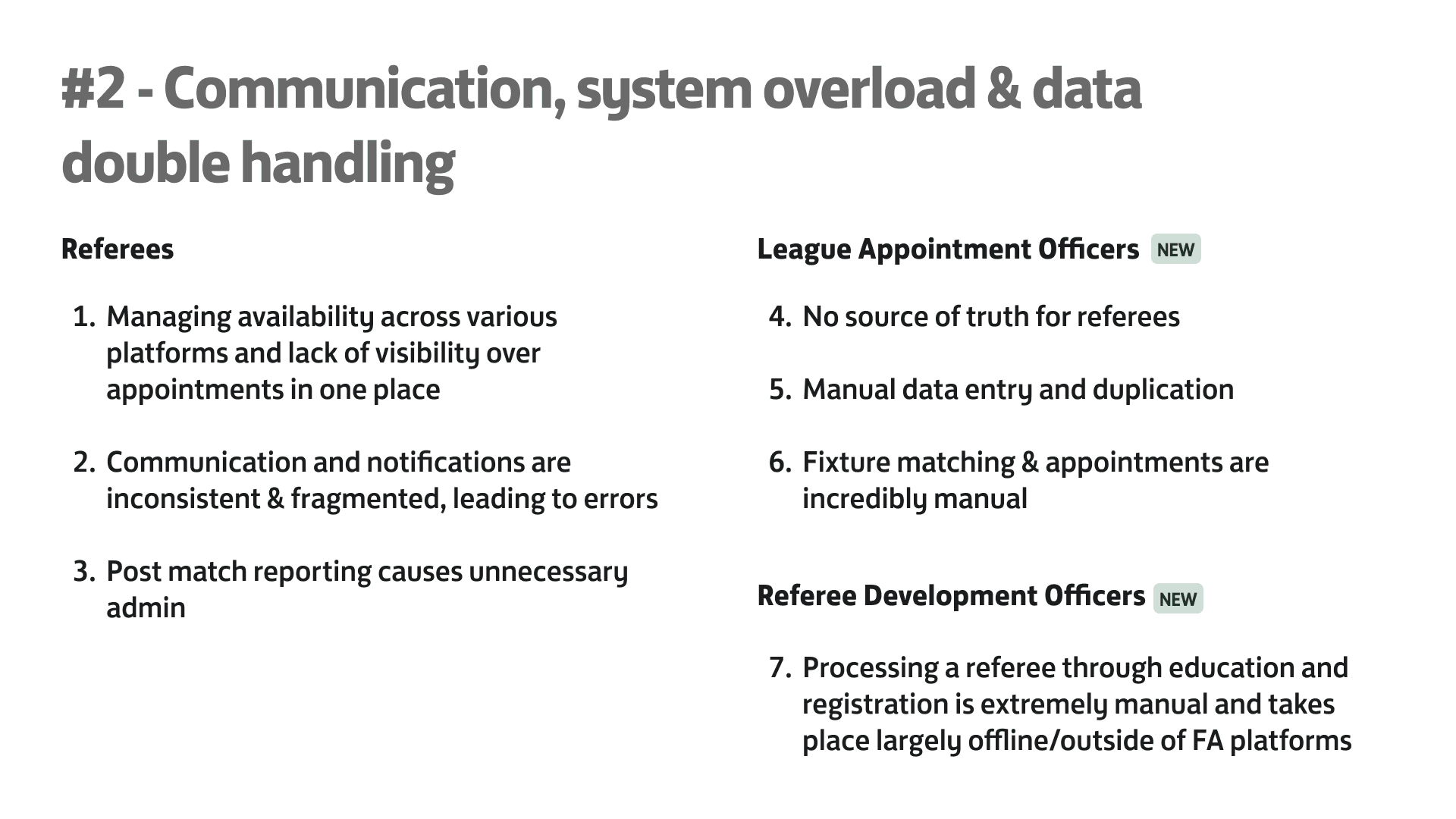
New themes & key takeaways for theme groups #3 & #4
To achieve project goals #1 & #2 and gain a deep understanding of the current state, it was important not to look at each journey in isolation. With this in mind, I built out a comprehensive process map, that connected the actions, platforms and pain points of the various groups at each stage of the journey.
This artefact helped gain alignment amongst project stakeholders and draw focus to challenge areas that impacted all user groups, building the story around what challenges were highest priority and presented the most substantial opportunity. We were left with a list of 9 key problem areas, which were labelled within context on the process map, a key quote that embodied the challenge was also added to each step to help bring the story to life.
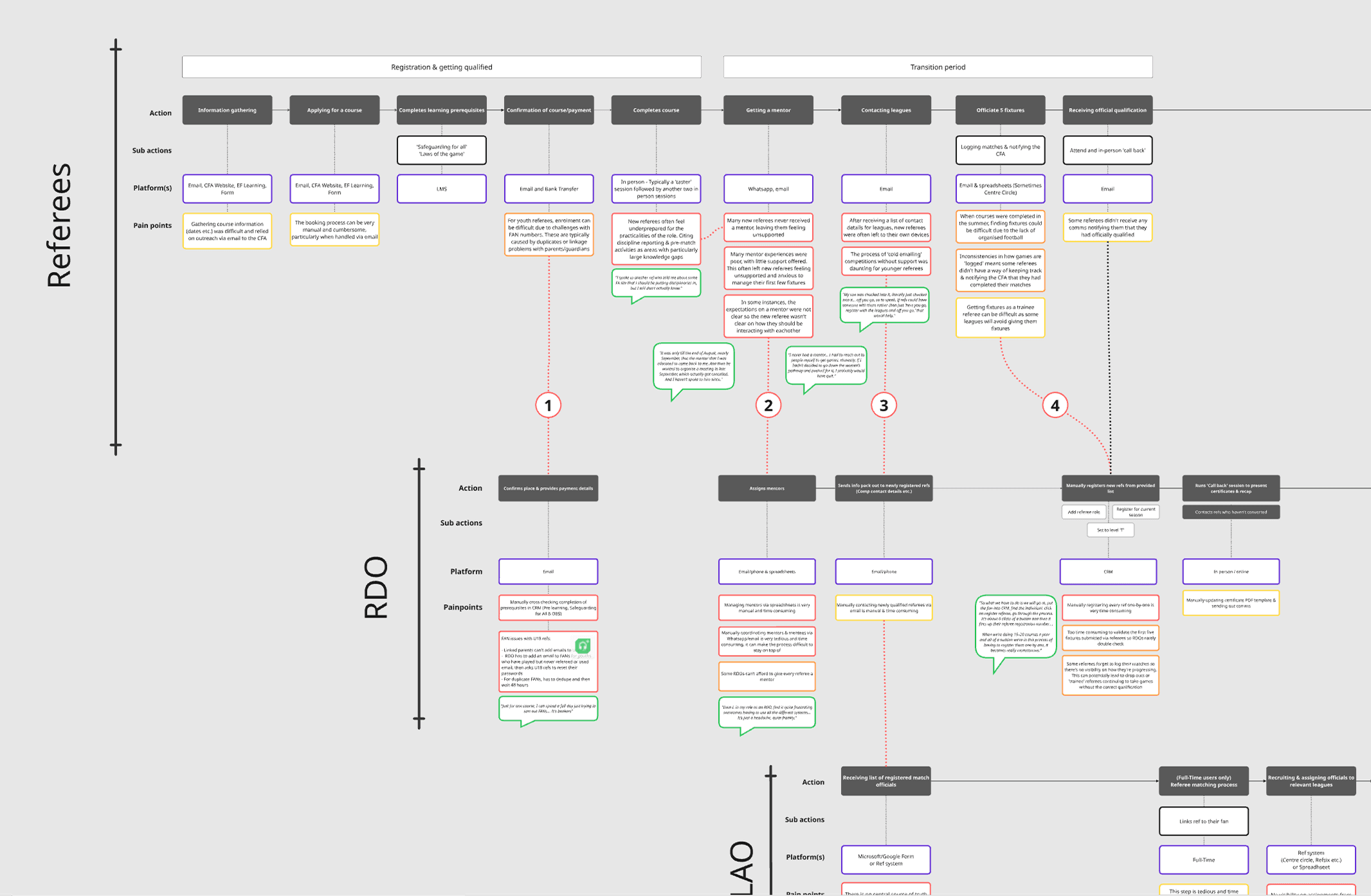
The connected journey map was the most critical artefact of the process, connecting the actions, platforms and pain points of all three user groups. This map became the alignment tool that shifted stakeholder conversation from opinions to evidence.
To bridge the gap between a detailed process map & set of solutions, the team utilised opportunity solution trees (OSTs). This approach helped keep stakeholders focused on challenges & opportunities rather than jumping straight to solutions (many stakeholders had preconceived ideas about the correct solutions prior to commencing the project).
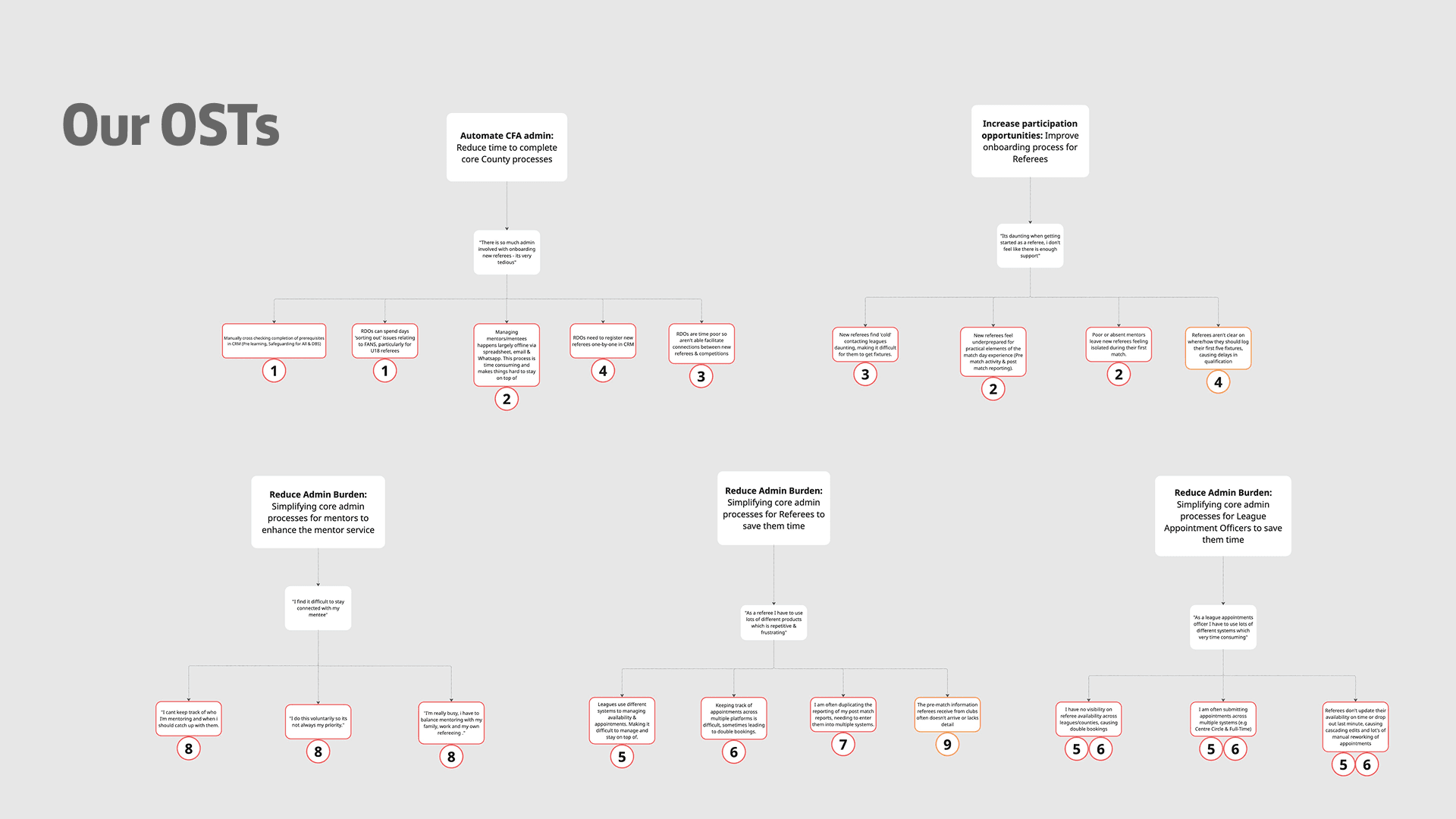
A zoomed out view of the OSTs presented to stakeholders, each branch was numbered to link it back to the detailed process map
Stakeholders were given one week to drop solutions under each branch of the respective trees. Prior to the ideation & prioritisation session, I grouped similar ideas and organised the board into a visual that could be easily navigated.
I led the the session, facilitating discussion around potential solutions for each branch. The workshop concluded with a dot voting exercise that helped prioritise potential initiatives, the key here was that this list considered both user needs/pain points and also business priorities.
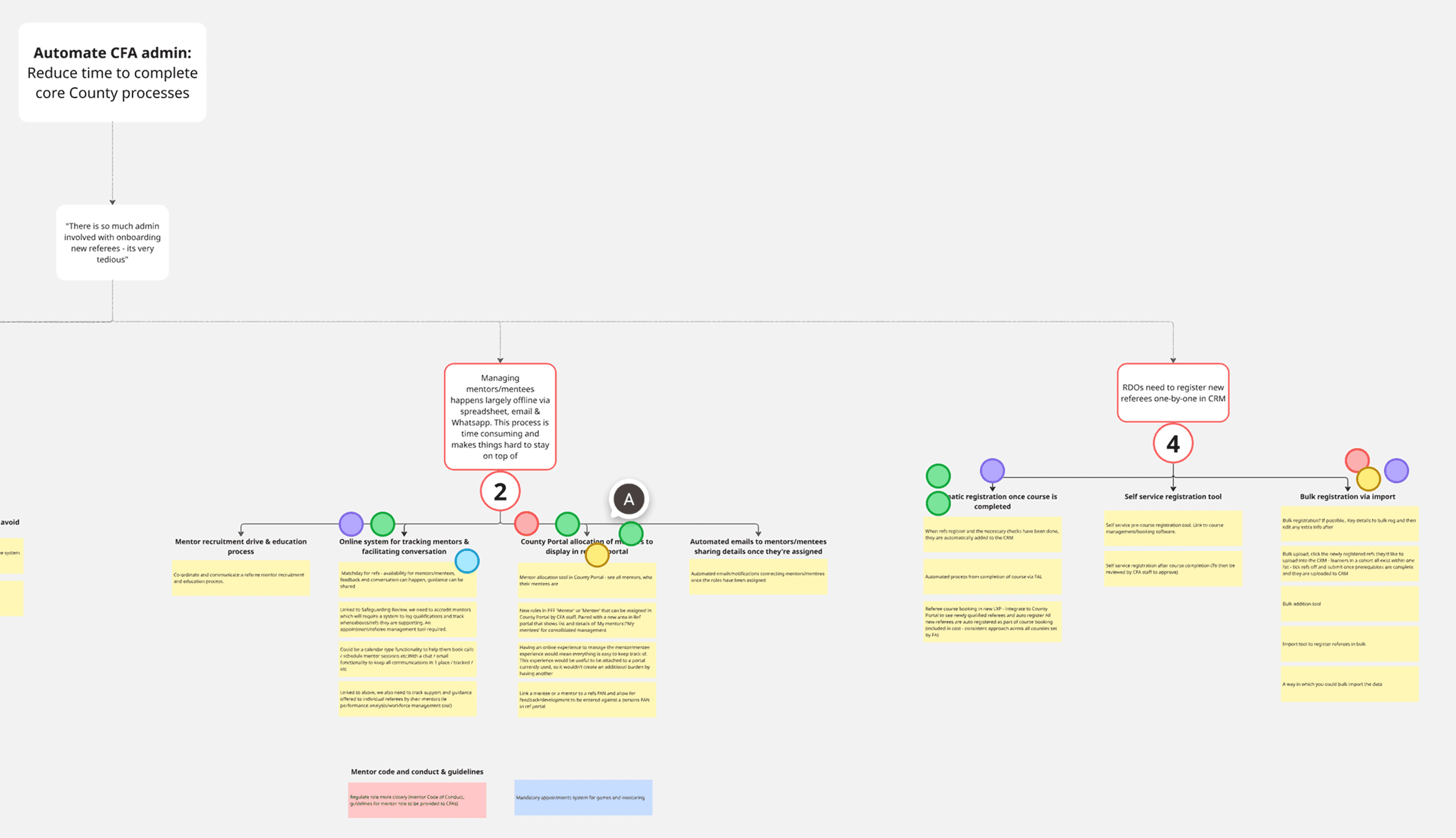
A detailed view of our completed OSTS following the dot voting exercise
Following our prioritisation session with business stakeholders, I led a process that helped map out a future architecture for our product suite that served referees, RDOs & LAOs based on the solutions prioritised by the group. This process involved consultation with specialists across various workstreams, including architecture, data & development. The key output here was a high level product architecture diagram which considered the following:
The structure of each platform and key actions/epics available on particular pages.
What data would be surfaced in which platforms, as well as the direction of travel when integrated.
Release phasing (MVP, phases 1, 2 & 3) that considered dependencies.
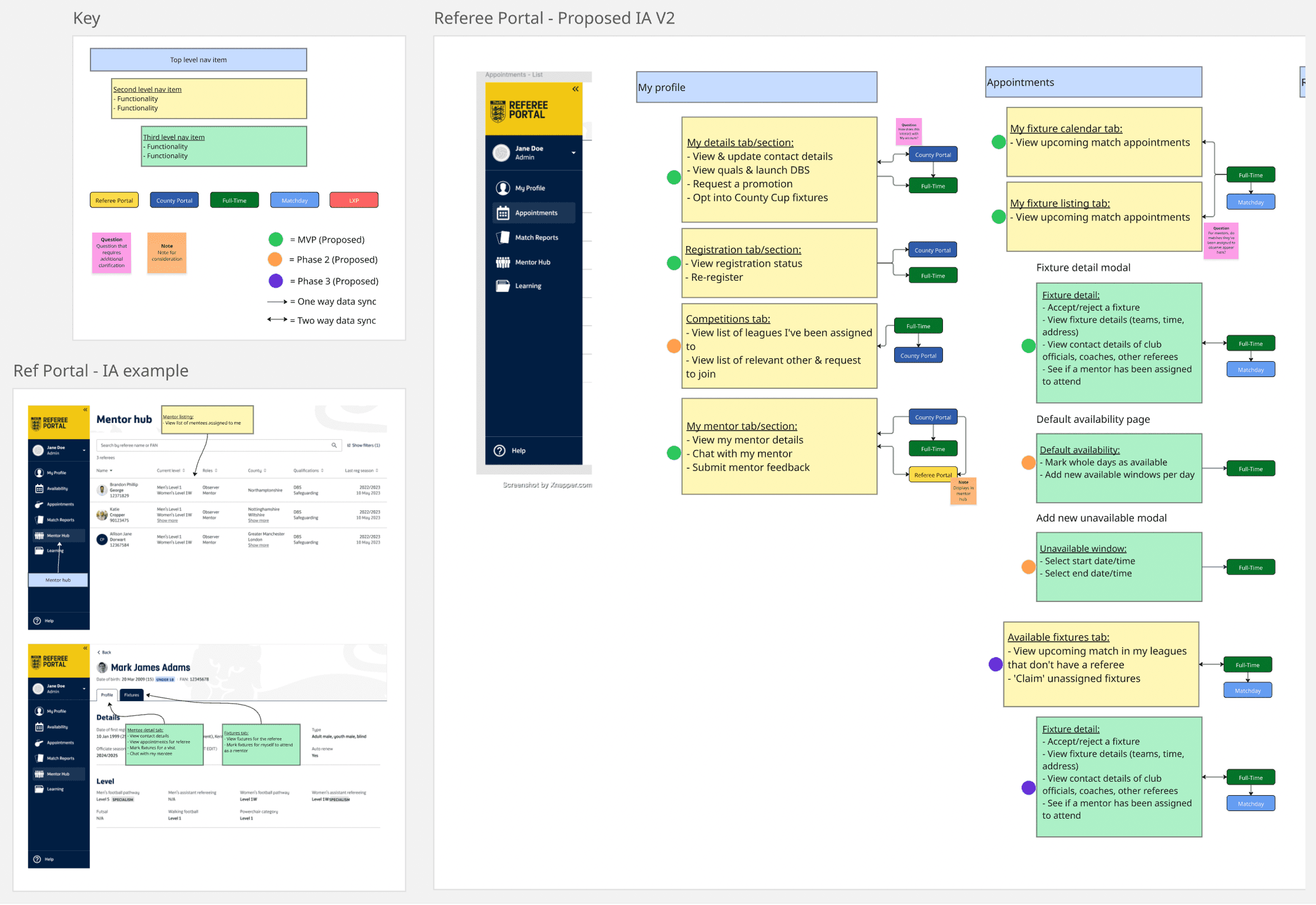
A snapshot of high-level architecture diagram used to align stakeholders and support estimation
In addition to the static architecture diagram, I also designed a set of conceptual prototypes in Figma to help visualise key flows in the suggested future state. This step was critical in gaining buy-in, particularly from non-technical stakeholders, but also helping developers and architecture gain a better understanding of the requirements for their investigation and subsequent high-level estimation.
One of the interactive prototypes built in Figma - For referees to update their default availability

Impact
A detailed & user-led 2 year roadmap connecting activity across four primary products presented to and approved by The FA board, with work commencing in June 2026.
Strong stakeholder alignment & buy-in across four business divisions on a solution that considered key technology and capacity dependencies, was clearly linked to divisional objectives and grounded in user research.
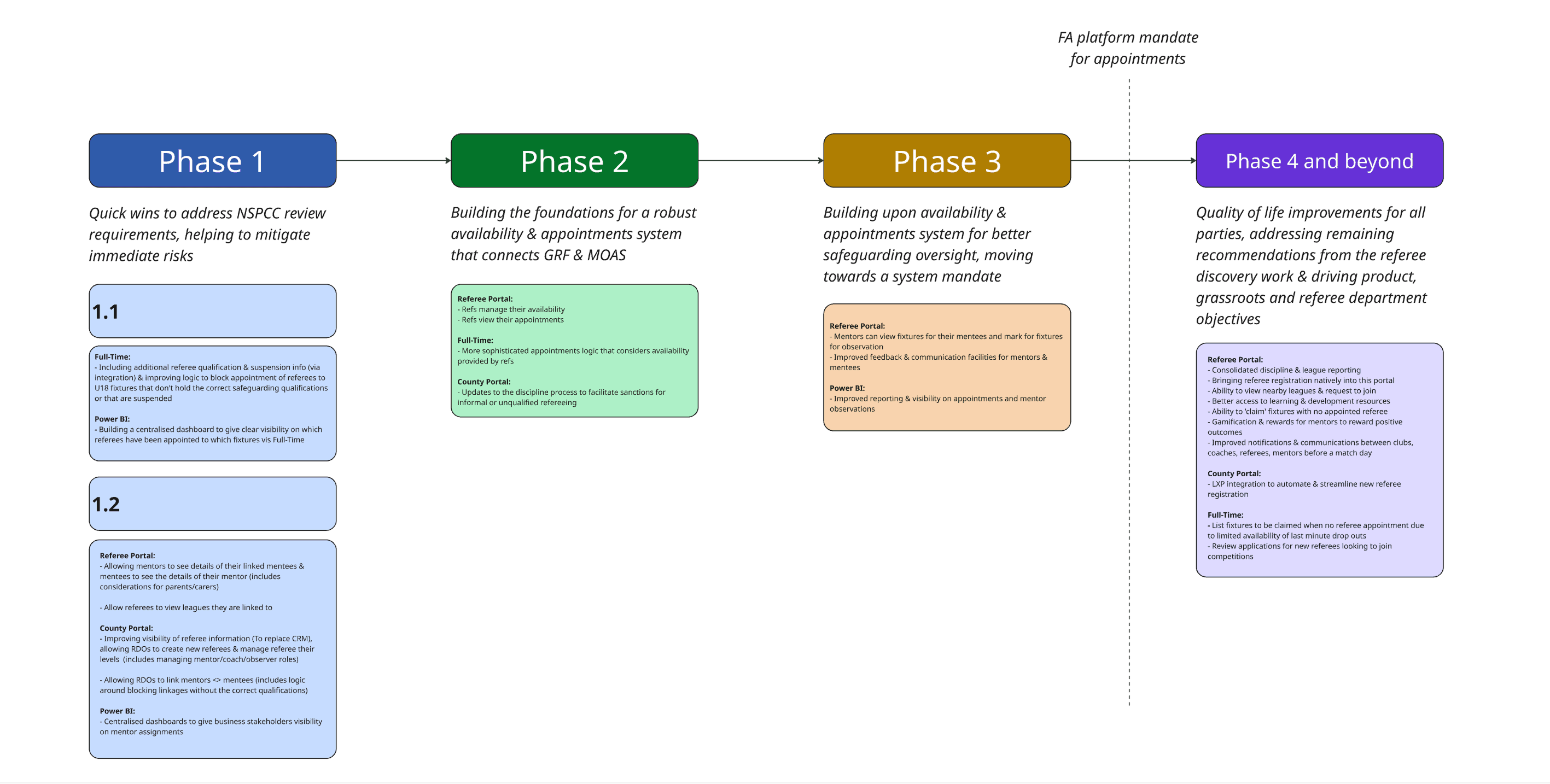
High level roadmap summary presented to board for approval
Takeaways
Consulting stakeholders at every step was critical in taking them 'on the journey'. Through fostering a real sense of co-creation and ownership we gained buy-in and engagement from non-technical colleagues.
